The post Featured destination: Seal Bay appeared first on Gone to the Dogs.
]]>Managed by the Comox Valley Regional District, Seal Bay Park has it all: endless walking and multi-use trails, an ocean playground, lots of wildlife and views of mainland mountains. It is over 652 hectares in size and is never crowded. There are leashed and leashing optional trails for dogs, although in the spring there is mandatory leashing due to nesting and fawning season.
One of the fun things about Seal Bay’s beach is that you almost always see seals, either on the rocks or swimming in the distance. We’ve even seen orcas!
Unfortunately the beach is rocky, but at low tide there is a bit of sand to play on.
Every season in this park has its own beauty. The fall colours are especially spectacular.
One of our favourite walks within Seal Bay is around Melda’s Marsh. Often you can see beavers swimming around in the evenings.
Although there are several ways to enter the park, the main lot is on Bates Road. From there you can take one of three trails that meander down to the ocean (get ready to work your legs coming back up), or cross the road for more trail options.
The post Featured destination: Seal Bay appeared first on Gone to the Dogs.
]]>The post Water safety with your pup appeared first on Gone to the Dogs.
]]>It sounds idyllic, but water and dogs don’t always go together so perfectly. While there are no confirmed statistics, it is estimated that about 5,000 family dogs drown in swimming pools each year. That doesn’t include any accidents that might occur at lakes, rivers or out on the open ocean among dog-owning boaters.
As with children and water, accidents can happen in an instant. To prevent accidents from occurring, dog owners should follow these eight tips for keeping dogs safe in and around the water.
1. Never Leave Your Dog Unattended Around Water
If you follow only one rule, let it be this one. Never leave your dog alone around water, whether it be a pool, lake, river or the open ocean. Even the strongest swimmer can have an emergency and if you’re not there to help, things can go wrong very quickly.
But don’t just stick close to your pup. Make sure you’re keeping an eye on him. Watch for signs he’s tiring, struggling with currents, or paying too much attention to something that could be dangerous. It’s not only the water that poses a risk when you’re out at the beach. Keep your dog away from fish and debris that wash up onto shore. You never know what might injure or sicken your dog if he tries eating it. Also keep him away from fishing tackle boxes, which are full of sharp hooks that can do a lot of damage.
If you’ve got a backyard pool, make sure it’s fenced in so your dog can’t get to it unless you’ve specifically decided to let her in. Don’t rely on a pool cover to keep your dog safe when you’re not around. Dogs expect the covers to be hard and get into trouble when they try and step onto them and get tangled up under water instead.
It’s helpful (for many reasons, not just water play) to learn canine CPR so you can do something if something goes wrong.
2. Understand Your Dog’s Breed
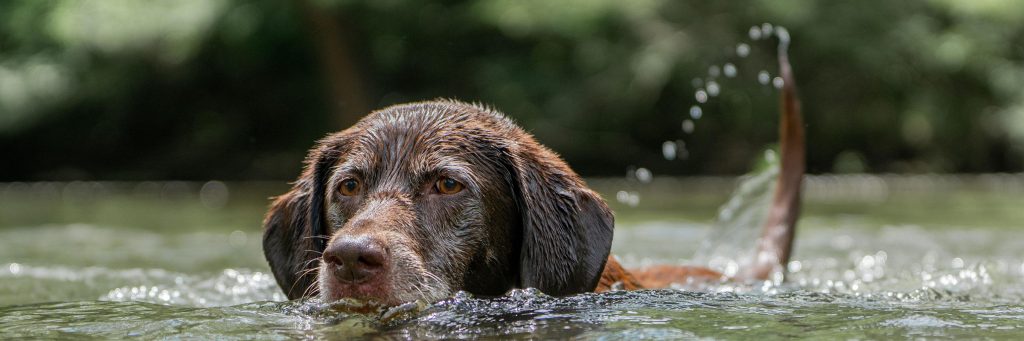
Not all dogs can swim. Even some who can, don’t do it very well and are at greater risk of drowning.
Golden and Chesapeake Bay Retrievers, Portuguese Water Dogs and Newfoundlands are some of the strongest swimming dogs out there. If you’ve got one of these, you have less to worry about. These dogs were bred to love the water and thrive in and around it.
Brachycephalic breeds, on the other hand, are terrible swimmers. Bulldogs, Pekingese, Pugs, Boxers and other dogs with flat faces and short snouts have trouble breathing while in the water, and, as a result, tire easily and quickly.
Other dog breeds have such small legs they can’t really paddle hard enough to keep themselves afloat. Some, like Basset Hounds and Corgis, can barely swim at all and will sink almost instantly.
As if they instinctively know the dangers water presents to them, most dogs of these breeds dislike the water in general. Never force your dog into the water if he doesn’t want to go.
3. Pay Attention To Water Conditions
You know that red flag on the beach that alerts swimmers it’s not safe to enter the water? It’s a sign for dog owners too. Undercurrents and big waves can mean big danger to dogs. So can water that’s too cold, especially for small dogs or those with less fur. Even just splashing around in freezing shallows can pose a risk to your dog.
If you’re heading to the river for some fishing or canoeing, be aware of the current. Fast currents can sweep dogs under in seconds. (Rivers with strong currents are a perfect example of when a life jacket comes in handy.)
At lakes, steer clear of water covered in blue-green algae, which can make your dog sick.
4. Make It Easy
While most swimming dogs have no problem launching themselves into the pool, getting out is more complicated. Make it easy by having stairs lead into the pool or installing a ramp they can more easily climb onto and trot up to get out.
5. Consider a Life Jacket

Life jackets can be life-savers. They keep your dog afloat when their legs are too tired to paddle or if they get sucked under the water by the current or a riptide. They make it easy to spot your dog in open water. And, the nifty handles make it a cinch to grab onto your dog and haul him out.
6. Take Breaks
Lots of sun and swimming can be tiring, for people and dogs. Pay attention to your dog’s energy levels and ensure she takes breaks throughout the day, preferably in the shade.
To enforce breaks, ensure your dog is command trained so you can tell her to sit and stay, even when all she wants is to get back into the water.
7. Rinse Off / Dry Off
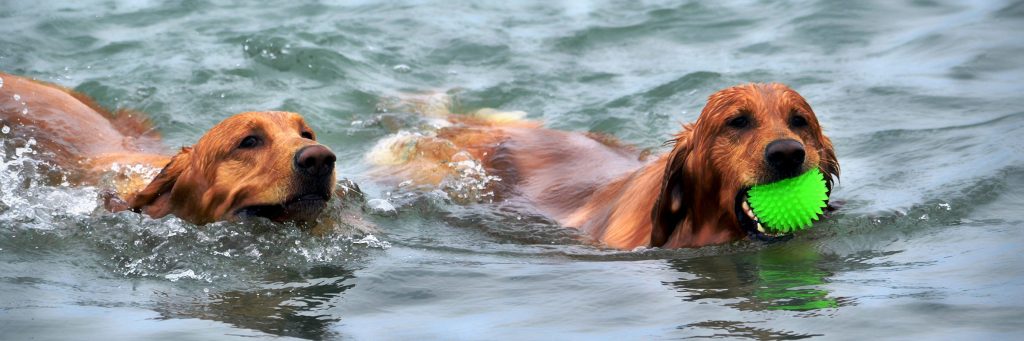
Whether your pup has been playing in the pool or splashing around at the beach, rinse him off when the day is over. Saltwater, chlorine, lake algae and any pollutants that made it into water can irritate your dog’s skin. And worse, make him sick if he licks his fur while he’s still wet.
You also want to dry your dog off, particularly in and around his ears to prevent an ear infection from occurring. You may want to use an ear cleaner once or twice a week if your dog is spending lots of time in the water on a daily basis.
8. Bring Drinking Water
Make sure to have plenty of drinking water for your dog, whether you’re hanging by the backyard pool (straight from a hose is fine) or fishing lakeside. As mentioned above, the water your dog enjoys splashing around in isn’t safe to drink. But being outside all day, in the sun and water stirs up quite a thirst. Keep your dog safe and dehydration at bay with a collapsible drinking bowl and lots of fresh water.
The post Water safety with your pup appeared first on Gone to the Dogs.
]]>The post How to write the perfect blog post appeared first on Gone to the Dogs.
]]>The nature of the blog is to bring value to your readers.
Why? Because marketing has changed. Free value to your audience = loyal readership = money in your pocket.
The blog is your chance to give back to your readers, your customers, and your audience. It helps your audience wade through all the “give me” out there and say, refreshingly, “have this.”
It doesn’t matter whether you have an online shop, a personal website or portfolio, you need to blog, at least occasionally.
If you blog regularly, Google will see your site as active, alive and relevant – and that will definitely help your overall rankings. In addition, blogging allows you to rank for new keywords and to keep ranking for those you’re already being found for. It allows your readers to get to know your brand and your products better. What’s more, you can use your blog to actively present yourself as a reliable source of information for prospective customers.
In total, there are 5 steps you should take when writing and publishing a blog post.
A step-by-step guide to writing an irresistible post
There are a lot of factors that contribute to making your blog post a success and you will find plenty of articles and guidelines out there, I’ve summarized the best of the best for you here.
Step 1: Choose your topic

The first step towards writing a blog post is to pick a good topic.
Don’t be fooled by thinking that you have to write something that’s never been written before. You just have to write it better than the competition did.
- Look at what your competitors are talking about (and what’s working for them)
- Reading through competitor’s and your reviews, and seeing what the pain points are
- Search your topic on the many websites out there that will tell you the most shared social posts on that topic
- Ask your customers and audience what they want to see
While you do your research keep a notebook handy where you can take down the important points and outline your topic.
When you choose your topic you must make sure that it is something that your audience will be able to relate to. You’ll need to find out what your followers want to know and read about, so your post will continue to get traffic after it’s published.
People read blogs because they are interested in what other people think, so don’t hesitate to make it personal, a reflection of yourself, your thoughts and opinions. Try to focus on what makes you unique, even if you’re in a competitive niche.
Claire Guiot, DIGITAL Design + Development Faculty
Step 2: Set the direction

Decide on the purpose of your post:
- You can write because you want to persuade people. You want to convince them to buy your product or adopt your ideas.
- The aim of your article could also be to entertain and amuse people. A column is a good example of an entertaining text.
- Your blog or article could also be informative. In this case, you write to share knowledge about a certain topic.
Come up with a working title. This will give you direction and will keep you on topic as you flesh out your post. You will probably change the title after you’ve finished editing your blog so don’t spend too much time on this thinking that it needs to be perfect.
Write an outline for your blog post. This is essentially a very concise list of the different topics or points you are going to cover and how they articulate. If you miss this step then your post will likely end up messy and off-topic.
Step 3: Write!

At this point, you’ll have all the information you need and an outline of the subjects you want to discuss in your blog post so it is finally time to start writing. Here are some guidelines to follow:
- Aim for 1000+ words. A higher word count helps Google to better understand what your text is about. And, generally speaking, Google tends to rank longer articles higher.
- Hook your readers with a great opening. If you can hook your readers with a good opening consider half your work to be done. Because if your introduction is boring, people wouldn’t bother to read the rest. Many writers find it easier to write the body of the blog post first, and save writing the intro for last.
- Write like you talk. Don’t overlook the style and tone of your writing. Both these elements can make a big difference. Writing like you’re talking to your reader will make it feel a lot more personal and add character to your copy. After all, you’re not writing an academic essay. Remember, nobody likes boring. Nobody likes stuffy. Have fun with it!
- Make it scannable. People usually don’t read blog posts word-for-word. Instead, they scan them for the information they’re looking for. That’s why it’s important to format your posts in a way that’s easy to scan. It’ll help your readers to get the info they’re looking for quickly, so they’re more likely to stick around your blog. Here are a few ways you can make your blog posts scannable:
- Use Subheadings: Subheadings help your readers to see the main topics of your post, and will help you to stay organized and on track when writing.
- Write Short Sentences: Short sentences are much easier to read. Long sentences can make it complicated to understand.
- Keep Paragraphs Short: When your paragraphs are too long, it’s harder to read. I recommend using 2-4 sentences in most of your paragraphs, with some 1-sentence paragraphs to grab the eye.
- Use Bullet Points: Whenever you have a list, you can use bullet points to make your message precise and clear and easy to scan, instead of listing items in a sentence.
- If you use these tips to make your text visually engaging, your readers will be more likely to read the whole post.
- Use images for visual engagement. A simple image has the power to make a boring post much more fun and engaging. It breaks the monotony of words and offers a refreshing visual break to the reader keeping them engaged for longer.
- Add a featured image. Believe it or not, your readers won’t waste more than 2 seconds to decide whether or not to click on your post. Adding an eye-catching featured image to your post is a great way to get more clicks, shares, and engagement. Shutterstock, Unsplash, and Pixabay are great platforms to help you find an appealing image to use. You can also use Canva or Photoshop if you want to edit them. Make sure you have the right to use the image you choose.
- Proof-read, spell check and edit out any unnecessary content. Revisit your working title to make it catchy and a good reflection of the content of the post.
Step 4: End with a CTA

Conclude your blog post with a call-to-action that indicates what you want the reader to do next. Whether it’s to ask your readers to leave a comment, share your blog post, follow you on social media, or purchase your product, make sure you clearly state what you’d like them to do.
Step 5: Optimize for SEO

I’m going to be quick here because there are millions (billions? trillions?) of “good SEO” resources that can be found on this subject, some with their own bible (I’m looking at you, Moz).
But, as a baseline, make sure to…
- Have a solid searchable title
- Use H1 Tags
- Fill out the meta description
- Add keywords
- Alt-tag your photos
- Re-write your url slug to be searchable, while removing stop points (and, or, to, etc.)
- A good rule of thumb is, at minimum, three internal links and three external links.
Writing a blog post can be a lot of fun, but it’s also a lot of work. You need to invest time in preparing your blog post, writing it, and even once it’s written, it’s important to make sure it gets the attention it deserves by sharing it. It might seem like a lot, but in the end, you’ll see your content perform well consistently. And trust me, it will be worth it!
The post How to write the perfect blog post appeared first on Gone to the Dogs.
]]>